Jan 6, 2013

"Habitats" Show comes to Yale University

The Guild of Natural Science Illustrators (GNSI) "Habitats" show continues, and my painting of the Red-cockaded Woodpecker now hangs in the Environmental Science Center at Yale University.  The exhibit space here is completely different from the walls of the Highstead Center.  The paintings are hung along a hallway, the entire length of which students, faculty, staff and visitors will traverse many times a day.

Habitats show on the exhibit wall in Yale's Environmental Science Center.
The space is illuminated by skylights, four floors above, which cast a glow of natural light on a four-story-high wall of Italian plaster, painted in a rich yellow-ochre color.  This is the second stop for our GNSI chapter's annual show, in this completely functional, but surprisingly lovely place.  The "Habitats" show will be on view through June.  This show's opening party will be held in March - we'll keep you posted, and it would be great to see you there!

GNSI members' business cards and the exhibit booklet

And, though it's still a l-o-n-g way off, Guild members have chosen "Camouflage" for the theme of our next show - I'm working on some ideas!  (September 2013)

Nov 16, 2012

Birding in Uruguay

landscape, departamento Treinta y Tres
If you've been to our AvesInArt website, you've seen Jorge's photographs of the beautiful and varied birds of Uruguay - his native country.  Early next year he will be guiding a birding tour to see some of these beauties.  

dry forest, Quebrada de los Cuervos, departamento Treinta y Tres
Here, I'll digress, to some etymology.  Uruguay, in spanish is pronounced something like "oo roo wai", and in english we've learned something closer to "yu ra gway".  At any rate - the name comes from neither spanish nor english.  Uruguay is a word from the native people of the region, the Guarani.  It translates roughly to "river of the colorful birds".

magnificent Ombue tree, Estancia Guardia del Monte, departamento Rocha
What could be more appropriate than birdwatching in a country named for the river of the colorful birds?  So, come along with Jorge on what promises to be a wonderful tour of Uruguay, visiting many easily accessible birding sites, such as wetlands and the unique Atlantic coastal forest.

Atlantic coast, Cabo Polonio, departamento Rocha
For more information, go to our Southern Screamer Birding Tours page at www.southernscreamer.com or you can get to the same page through our AvesInArt website, www.avesinart.com - under the "More" heading, find the "Birding Tours" page.

Valle del Lunarejo, departamento Rivera
Contact Jorge by email if you have questions:
birdinguruguay@southernscreamer.com
or fill out the inquiry form on the website.

Mark your calendars for February 18 - 28, 2013, and make a deposit to reserve your place on this customized, personalized birding tour to see the colorful birds of Uruguay.
 
inner courtyard, Estancia Guardia del Monte
All photos are Jorge's - from a recent birding trip to Uruguay.  To see the actual birds, click here to jump to AvesInArt's Birds of Uruguay photo gallery.

Sep 8, 2012

Highstead art exhibit

Subtitle:
Highstead collaborates with the Guild of Natural Science Illustrators' Greater New York chapter to showcase artwork on the theme of "Habitats, flora & fauna in natural settings".
Background:
Highstead is a 150-acre preserve/arboretum/research area in Redding, Connecticut.
The Guild of Natural Science Illustrators (GNSI) is a 1000-member society of artists working in the field of, well, depicting natural science through works of art. 
Browsing the "Habitats" exhibit on opening day.
Today's story:
This morning, Saturday, September 8, 2012, nearly fifty people gathered at Highstead for the opening reception of the art show and a conservation presentation that followed.  Guild members exhibited drawings and paintings on the theme of Habitats.  With such a broad topic, the pieces were bound to be diverse, and they were.  
attendees intently studying the artwork and accompanying texts
To start off the presentation, Highstead staff introduced Guild leaders who introduced the show and then invited artists to give brief descriptions of their work.  This is the second Guild show I have participated in, but the first grand opening I've attended.  I was as much viewing the artwork as taking in the scene of my colleagues, their evident pride in their accomplishments, and the exhibit space at Highstead.
Dorie Petrochko talking about her Milford Harbor painting.
My entry into the juried show was my watercolor painting of the Red-cockaded Woodpeckers - which has been well documented in this blog.  And, like my colleagues, I was proud and pleased to see the effect of my piece within the show as a whole.
Me describing the unique habitat of the Red-cockaded Woodpecker.
http://www.highstead.net/
http://www.gnsi.org/

Rex Brasher, Connecticut's 20th Century Bird Artist

In an earlier post I mentioned an exhibition at the University of Connecticut of Rex Brasher's prints.  I hoofed it over to the State Museum of Natural History one day after work, had the gallery space to myself, and browsed the collection in a quiet solitude that I imagine the artist himself would have recognized.


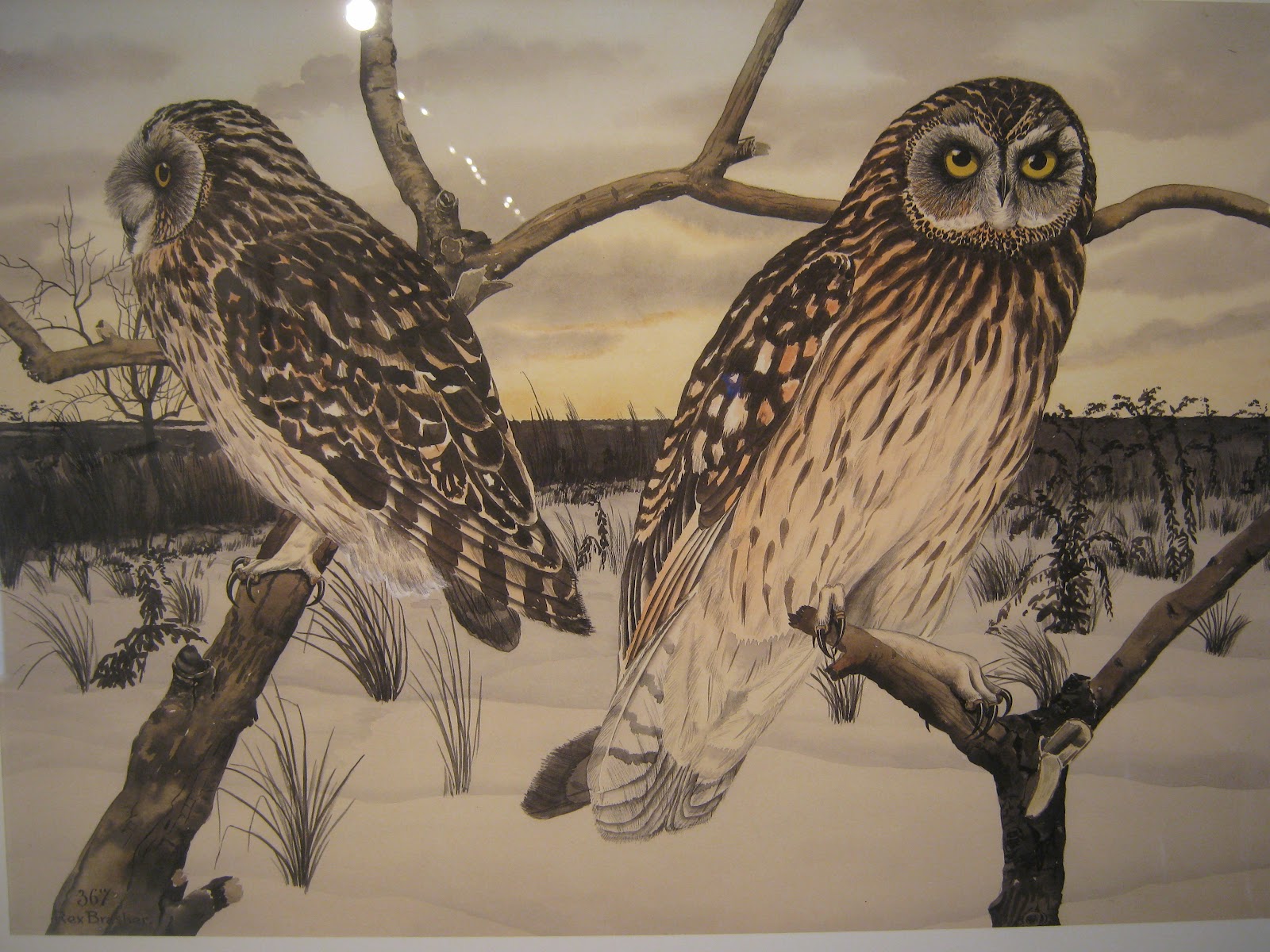
The simple display invited close inspection, and I thoroughly enjoyed the ability to stand six inches from the Short-eared Owl to take in the brilliance of the golden eyes and the detail of the fine feathering framing that piercing stare.

Rex Brasher's Short-eared Owl
detail, Short-eared Owl, Rex Brasher, artist
Remember, all of these pieces are black and white lithographs which the artist then hand-colored with airbrush.  When I look at the face of this owl I first see the intense ferocity of the predator and second the artistry that captured that gaze.  A bright reflection in the upper left corner and a simple glaze of gray suggesting the nictitating membrane, together create the curvature and depth of the owl's eye.  Masterful!

Rex Brasher's Red-headed Woodpeckers
Having just worked on my own painting of woodpeckers, I appreciate the thought that goes into this composition.  Two birds are more dynamic than one, a bit of foliage suggests the type of tree the species might favor and the bark detail is inviting but not overwhelming.

detail of the male Red-headed Woodpecker, Rex Brasher, artist
Can I say again - remember - these are black and white lithographs, handpainted.  The planning that goes into such a feat is staggering, and Brasher repeated it how many hundreds of times?  Eight hundred and seventy four species, one hundred sets of prints.

Jun 22, 2012

Coastal Birding

Part 1 - New Hampshire Pelagic
New Hampshire Audubon advertised a pelagic birding trip in early June to Jeffrey's Ledge, an underwater glacial ridge 35km off the coast of New Hampshire.  The trip departed in dense fog from Rye Harbor at 8am for an all-day birding excursion on the MV Granite State.  Guided by NH Audubon leader Steve Mirick, we were two in a group of about fifty birders.

Sue and Jorge dressed for a day of pelagic birding.
Group birding etiquette
Steve advised us on seabirding etiquette:  Shout out a description of what you see, (dark bird, flying low) and give an idea of direction and distance (2 o'clock, halfway to the horizon, moving left to right).  To explain, if the forward direction of the boat is considered as noon, then 2:00 is 60 degrees off the starboard bow - you see?  who knows what the "starboard bow" is? who can quickly calculate 60 degrees?  so, 2 o'clock is a simple way to indicate direction.

Isles of Shoals
The first point of interest was the Isles of Shoals, six miles (10km) out in the Atlantic.  A group of small rocky islands, "Shoals" is partly in Maine and partly in New Hampshire, with a centuries-long history of habitation, by fishermen, vacationers and seabirds.

Star Island Hotel seen from Gosport Harbor, Isles of Shoals, New Hampshire
Pausing offshore of Seavey Island, we watched the thriving colony of Common Terns.  Nearby Square Rock is a favorite roost for Double-crested and Great Cormorants and that day hosted one Northern Gannet as well.  Star Island's Gosport Harbor sheltered several Black Guillemots, and we lingered to watch a surprise Summer Tanager on the rocky shore of Smuttynose Island.

Other marine life
The boat's captain and crew were familiar with local marine life, and pointed out enormous basking sharks (Cetorhinus maximus), huge schools of young mackerel (Scomber scombrus) and minke whales (Balaenoptera acutorostrata).  Cruising eastward through continued thick fog, we picked up very few seabirds - one lone Northern Fulmar, a pair of Red-necked Phalarope, and a fishing flock of Northern Gannet mixed with Herring and Black-backed Gulls.

Young Humpbacked Whale - Pinball's baby.

Nearing Jeffrey's Ledge, the captain changed course to bring us close to a mother and baby Humpbacked Whale (Megaptera novaeangliae).  What a thrill to observe these enourmous mammals at close range.  Biologists can recognize individual adults by unique patterns on the tail flukes - we were watching Pinball and her calf, born this winter off the Dominican Republic.

Finally - seabirds
By early afternoon the fog finally lifted, revealing the pelagic birds that we had come out to Jeffrey's Ledge to see - Wilson's Petrels (Oceanites oceanicus), Sooty Shearwaters (Puffinus griseus), and one lone Parasitic Jaeger (Stercorarius parasiticus).  Despite the fog and the low numbers of birds, it was all-in-all a fantastic day out on the ocean.


Part 2 - Machias Seal Island
Home to a vibrant colony of Atlantic Puffins, Machias Seal Island sits ten miles (15km) out to sea, in the Gulf of Maine.  Claimed equally by the United States and Canada, the island is administered and inhabited by the Canadian Coast Guard.  Access to the island is controlled, with only two tour companies landing each day - the US tour in the morning, the Canadian tour in the afternoon - every day from mid-May through August.


Cutler Harbor, 7am, awaiting the Barbara Frost.

We sailed with the Bold Coast Charter company out of Cutler, Maine, with Captain Andrew Patterson on his sturdy Downeast fishing boat, the Barbara Frost.  Our group numbered about 18, with a mix of birders, photographers and puffin enthusiasts.  While his young assistant piloted the boat, Andy chatted about the seabirds, marine life in general, and how lucky we were to have a day with calm seas.  Nearing the island, Razorbills (Alca torda), Common Murres (Uria aalge) and Atlantic Puffins (Fratercula arctica) were numerous in the water and air - "buzzing" back and forth on rapid wingbeats, floating in groups and diving for fish.

Machias Seal Island lighthouse and Coast Guard station, with two observation blinds visible as tiny gray boxes in front and to the right of the light house.  (Razorbill flying by!)
Ashore at Machias Seal Island, we again listened to a stern lecture about birding etiquette, this time delivered by the coastguardsman / resident naturalist,  .  Strict adherence to protocol is necessary to minimize human impact on the seabird colonies.  Our group was divided in half, with one half heading directly for a one-hour session in the blinds, and the other half waiting behind to watch the wheeling Arctic Terns (Sterna paradisaea) and foraging warblers.
In the center of the photo, two of the observation blinds which were visible from the window of the blind we were using.

Once inside the blind, we opened the window-covers, set up tripod and camera and began an amazing hour of puffin-watching.  The birds were as close as three meters away and in constant motion - hopping from rock to rock, flying to a more distant perch, preening, vocalizing to each other - a tremendous clamor of activity.  Razorbills and Atlantic Puffins were nearby, with the Common Murres a little more distant.  None of the birds showed signs of feeding chicks in the nest burrows, so we guessed the pairs were incubating or had not yet laid eggs.

Our group of 18 was processed through the four blinds in two hours, marched back down to the boat ramp and sent on our way.  Captain Andy clearly enjoys his work, taking time to guide the Barbara Frost on a prolonged tour through the waters around the island, pausing to watch Gray Seals (Halichoerus grypus) and Harbor Seals (Phoca vitulina) and even giving us good looks at the poster bird of the spring...

A first ever breeding record of Northern Gannet (Morus bassanus) was documented for Machias Seal Island this spring.  The pair built a nest, laid an egg and incubated for several weeks - but the day before we arrived on the island, the resident naturalists said the egg was gone.  The bird was still sitting on the nest as we motored by.
I loved the emerald green mosses in the maritime spruce-fir forest along the Western Head Trail, part of coastline under the stewardship of the Maine Coast Heritage Trust. - the rain forest of Maine!
Maine coast palette
View back towards Cutler from the Western Head trail

Rex Brasher's bird art and birding Kent's River Road

Sunday afternoon, May 20th, we took another field trip which combined birding and a bird artist.  The town of Kent, in western Connecticut is famous in birding circles for its spring warbler migration, and perhaps less famous for its early 20th century bird artist, Rex Brasher.  What drew us there on this particular day was a presentation about Rex at the local historical society - coinciding with, well, spring migration.

Spring woodland along River Road in Kent, Connecticut
Kent Historical Association Presentation
The Kent Historical Association hosted two grand-nieces of artist Rex Brasher (pronounced not the way I expected, but instead BRAYzher), Deborah and Melode Brasher, who read a prepared biography of their great uncle and told a few stories with some local color. On display were some hand-colored prints and a few books.

Roseate Tern, Sterna dougallii, hand-colored lithograph by Rex Brasher
Rex Brasher biography
It's difficult to summarize Rex Brasher's life.  Born in 1869, died in 1960, painted, travelled, struggled, triumphed, struggled and painted some more.  As a young child, he heard his father's story of having been snubbed by the aging John James Audubon, and determined to right the wrong by painting every North American bird, from life.  To this end, he travelled to all corners of the United States to study birds, and earned money in various ways to support his travels and his life as a painter.

Greater Roadrunner, Geococcyx californius, (detail), hand-colored lithograph by Rex Brasher
In 1924 he painted the 874th and final bird of the series, the LeConte's Sparrow.  Color reproductions being too expensive to publish, he found an engraver to make black and white lithographs, which he then hand colored.  The finished book, Birds and Trees of North America, was presented in twelve volumes, and sold by subscription - only one hundred copies were made.

In 1941 Rex Brasher's original paintings and prints were purchased by the state of Connecticut, eventually to land at the University of Connecticut, where they are housed in the Thomas J. Dodd Research Center's Archives and Special Collections.  The Dodd Center is a UConn library, and is open to the public.  Link to page for the Brasher Collection.
Secrets of the Friendly Woods. Musings on Rex's Connecticut woodlands and its inhabitants.
New Brasher exhibit
The head of the Board of the Rex Brasher Foundation spoke of renewed efforts to increase the visibility of the great opus of Rex Brasher's life, his Birds and Trees of North America.  The most visible of these efforts is an exhibit of fourteen paintings at the Connecticut State Museum of Natural History.  On exhibit are digital reproductions, not the originals, and the intent is that this set, grouped as "The Endangered and Threatened Birds of Connecticut", will be a travelling (and fund-raising) show.

Now back to Kent
To bring my story full circle, midway through his life, Rex Brasher purchased a 150-acre farm near Kent, Connecticut, where he lived and painted and associated with other artists and naturalists.

Yellow-throated Vireo, Vireo flavifrons, www.avesinart.com
Birding Kent's River Road in May
Northbound songbirds follow the Housatonic River and its adjacent mountain ridge, and are abundant in early May in the woodlands along an unpaved road that follows the river's western shore - River Road. Where the road ends, a broad, well-traveled footpath continues - the Appalachian Trail - traversing the northwest corner of Connecticut.   Geology and topography combine to create a beautifully inviting atmosphere for any outdoors enthusiast - cool shady woods for hiking, a fast-flowing river for paddling, unique plant communities for botanizing, and of course the migrating songbirds.

We had far more mosquitoes than birds, but the birds were beautiful ones:  Cerulean Warbler, Blackburnian Warbler, Northern Parula, Yellow-throated Vireo, Red-eyed Vireo, Scarlet Tanager, Black-billed Cuckoo, Great-crested Flycatcher, Common Nighthawk, Purple Martin, Common Merganser and many more. 

Cerulean Warbler, Setophaga cerulea, www.avesinart.com
Find directions to River Road at end of this post.

Housatonic Valley Geology - an interesting digression
Geologically, the Housatonic River valley is complex, with the low but steep mountains formed of folded and faulted metamorphic bedrock (Precambrian gneiss and schist).  During the Paleozoic era, much of the river valley was underwater - salt water - which left behind a carbonate sediment of shells and marine fossils. This material became limestone, which metamorphosed into marble - visible in the exposed outcrop at Kent Falls State Park, just north of the village of Kent.

More Brasher links:
Link to an art gallery website which has images of plates of Brasher's Birds and Trees of North America as well as excerpts from a biography written by nephew Milton Brasher.
Link to that biography at Amazon and link to same at Google books.
http://www.kentart.org/kaafound_hist.htm - the Kent Art Association
http://www.nytimes.com/2008/08/03/nyregion/nyregionspecial2/03kentct.html?pagewanted=print - New York Times article "Painter of Birds to Finally get a Home"
Link to my source for explaining the geology that was so evident all around us in the woods along River Road.

Directions to River Road, Kent:
From the center of Kent, cross the river on Bridge Street (route 341), immediately turn right (N) on Skiff Mountain Road, and follow for 3 miles (you'll pass the athlectic facilities for Kent School), keep going to the end where there is space for a few cars to park.

Mar 28, 2012

Still painting!

I though you might like to see how the woodpecker painting is coming along.

Here I have begun to "block-in" the dark areas.

Details in the face really add character!

The pinecone and needles are an important part of the composition.