Showing posts with label European Starling. Show all posts

Jan 30, 2025

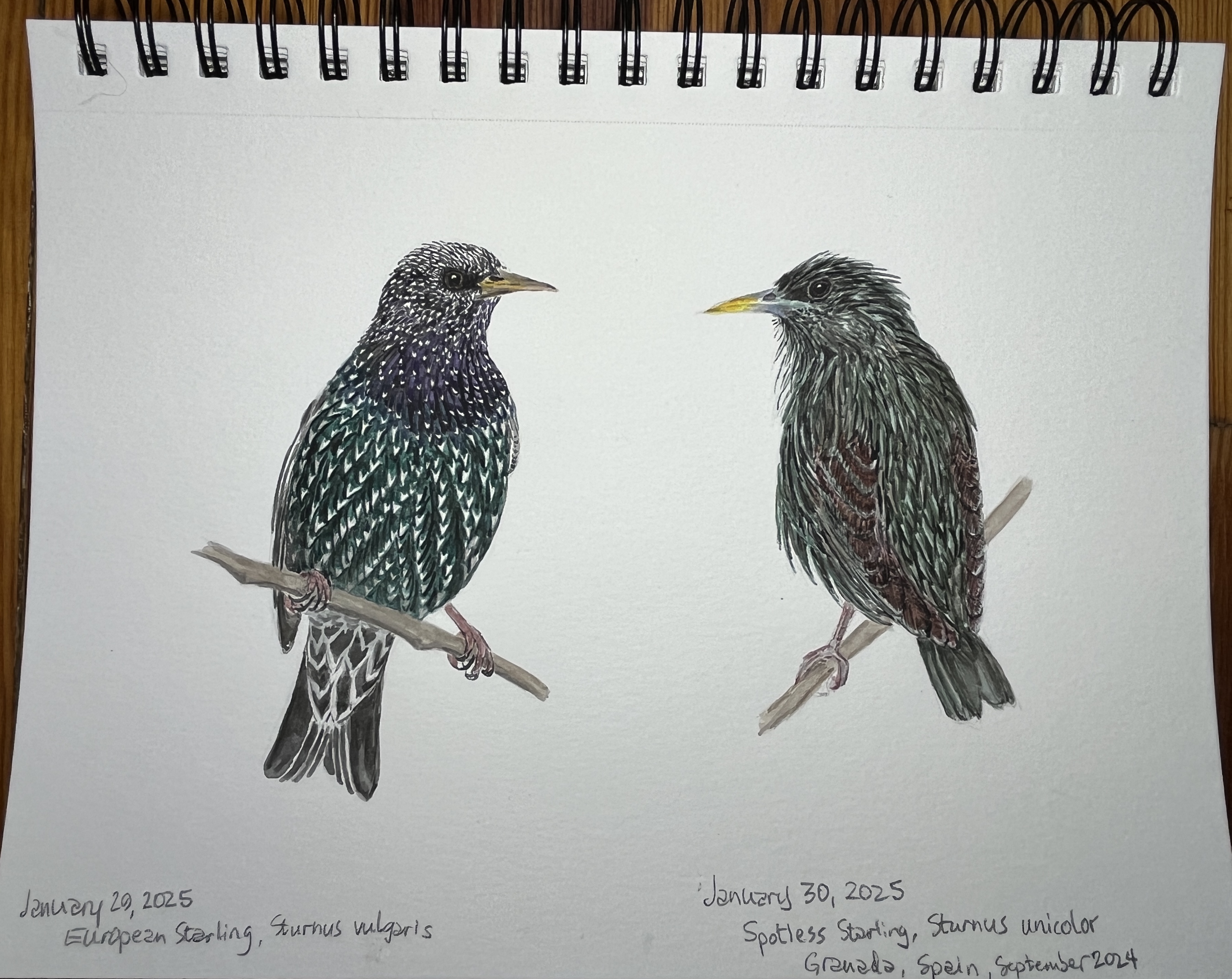
Penultimate day of our January Challenge, version 2025! I finished part two of yesterday's sketch, and it's a bird with a funny name, I mean, it's named for a feature it does NOT have. Meet the Spotless Starling, Sturnus unicolor, found throughout Spain and into nearby areas, including Morocco. This bird was a real target of mine - for the name alone! It really is this shaggy, and usually appears black, with green and bronzy-purple iridescence.
Spotless Starling Sturnus unicolor
Granada Spain, September 7, 2024

Starlings, with and without spots
European Starling and Spotless Starling

New birds have been a challenge to find again, as cold and windy days have returned to Connecticut (after a few pleasant days). Today Jorge brings you our feisty Black-capped Chickadee, year-round resident and a familiar visitor to backyard feeders.
Black-capped Chickadee, Poecile atricapillus
on a branch of Staghorn Sumac, Rhus typhina


Jan 29, 2025

 Today's painting was ambitious, and I finished only half of it. Tomorrow will be part two! Stay tuned... The familiar European Starling sports a really incredible coat in the non-breeding season - iridescent purple and green with little chevrons of white at the tip of each feather. When the breeding season rolls around, the feather tips have mostly worn away, leaving a uniform black-looking bird - this is called "wear molt" even though it's not technically a molt.

European Starling, Sturnus vulgaris, in non-breeding plumage

Jorge's bird for today is one that uses the nest boxes around Horsebarn Hill in the springtime. This time of year when everything is gray and brown, the Eastern Bluebird is a little fleck of the bright sky flitting through the landscape - in fields, woodlands and even our yard. 
Eastern Bluebird, Sialia sialis, Windsor, Connecticut
- male, perching on a poison ivy vine -


Jan 15, 2025

The easiest way to portray a bird is in profile. Perhaps it's the best way to show the proportions - the length of the beak relative to the head, and so on. Today I'm trying to stretch my skills to show the bird in some different postures. This is one of our favorites, the Carolina Wren, whose cheerful song brings joy all spring and summer - really it does. And they stick around through the winter too, visiting our feeders and finding insects hidden in the woodpile.

Carolina Wren, Thryothorus ludovicianus
Storrs-Mansfield, Connecticut, year-round

With the sustained cold weather we've had this month, water is a real magnet for birds. Jorge found these European Starlings taking advantage of a bird-sized water supply on campus in the afternoon.

European Starling, Sturnus vulgaris
UConn campus, Storrs, Connecticut

Jan 29, 2015

Day 29 of the Challenge

January 29th - a day spent indoors, so another indoor selection for bird-of-the-day. A row of study skins in the University's research collection.
EUROPEAN STARLING (Sturnus vulgaris). Study skins. Pencil
January 29, 2015. UConn's Biological Research Collections.
MALLARD (Anas platyrhynchos). Connecticut River at Enfield, Connecticut.
January 2015.

Jan 9, 2015

January Challenge continues

Day 9 - After a sudden snow squall, the day was bright and sunny - but still very cold. I found this pair of doves resting with fluffed-out plumage to keep warm.
MOURNING DOVES, Zenaida macroura. Colored pencil and sharpie marker.
Hamden, Connecticut, USA.
The ever-present starlings caught Jorge's attention again. This bird's common name derives from its winter plumage - starry spots on iridescent black plumage.
EUROPEAN STARLING, Sturnus vulgaris. Storrs, Connecticut, USA.

Challenge Day 7

Day 7 of the challenge was again quite a challenge.  Jorge found the starling flock taking grain from the cows' feeding troughs.
EUROPEAN STARLING, Sturnus vulgaris, UConn's Horsebarn Hill.
On my brief outing today, I saw exactly zero birds, so I share with you an acrylic sketch I made last month in Costa Rica. The toucans were my favorite birds from that trip - so crazily gaudy!
KEEL-BILLED TOUCAN, Ramphastos sulfuratus. Acrylic on canvas board.
Provincia de Alajuela, COSTA RICA.