| Spotless Starling Sturnus unicolor Granada Spain, September 7, 2024 |
| Starlings, with and without spots European Starling and Spotless Starling |
![]() |
| Black-capped Chickadee, Poecile atricapillus on a branch of Staghorn Sumac, Rhus typhina |
| Spotless Starling Sturnus unicolor Granada Spain, September 7, 2024 |
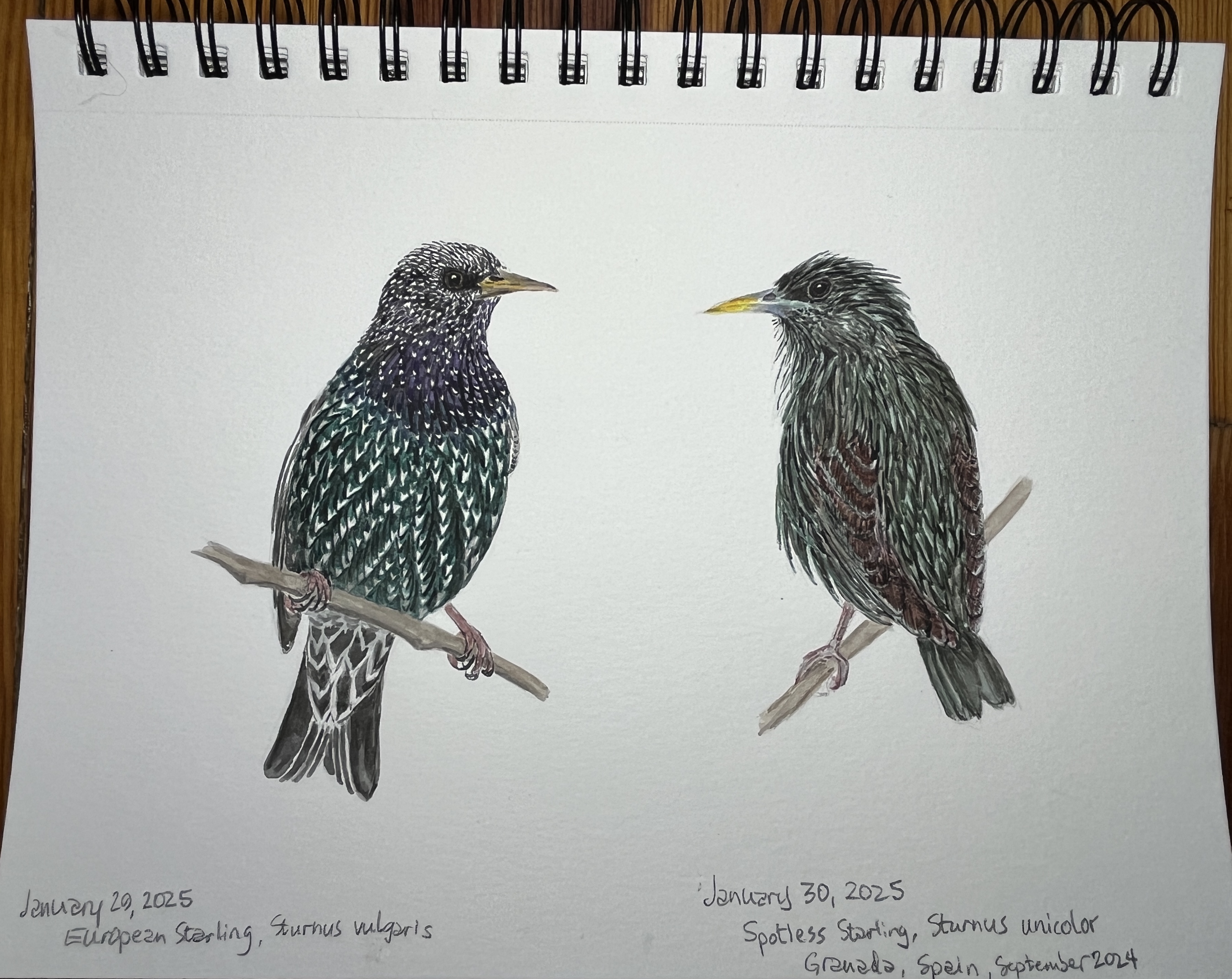
| Starlings, with and without spots European Starling and Spotless Starling |
![]() |
| Black-capped Chickadee, Poecile atricapillus on a branch of Staghorn Sumac, Rhus typhina |
Today's painting was ambitious, and I finished only half of it. Tomorrow will be part two! Stay tuned... The familiar European Starling sports a really incredible coat in the non-breeding season - iridescent purple and green with little chevrons of white at the tip of each feather. When the breeding season rolls around, the feather tips have mostly worn away, leaving a uniform black-looking bird - this is called "wear molt" even though it's not technically a molt.
| European Starling, Sturnus vulgaris, in non-breeding plumage |
![]() |
| Eastern Bluebird, Sialia sialis, Windsor, Connecticut - male, perching on a poison ivy vine - |
The easiest way to portray a bird is in profile. Perhaps it's the best way to show the proportions - the length of the beak relative to the head, and so on. Today I'm trying to stretch my skills to show the bird in some different postures. This is one of our favorites, the Carolina Wren, whose cheerful song brings joy all spring and summer - really it does. And they stick around through the winter too, visiting our feeders and finding insects hidden in the woodpile.
| Carolina Wren, Thryothorus ludovicianus Storrs-Mansfield, Connecticut, year-round |
![]() |
| European Starling, Sturnus vulgaris UConn campus, Storrs, Connecticut |