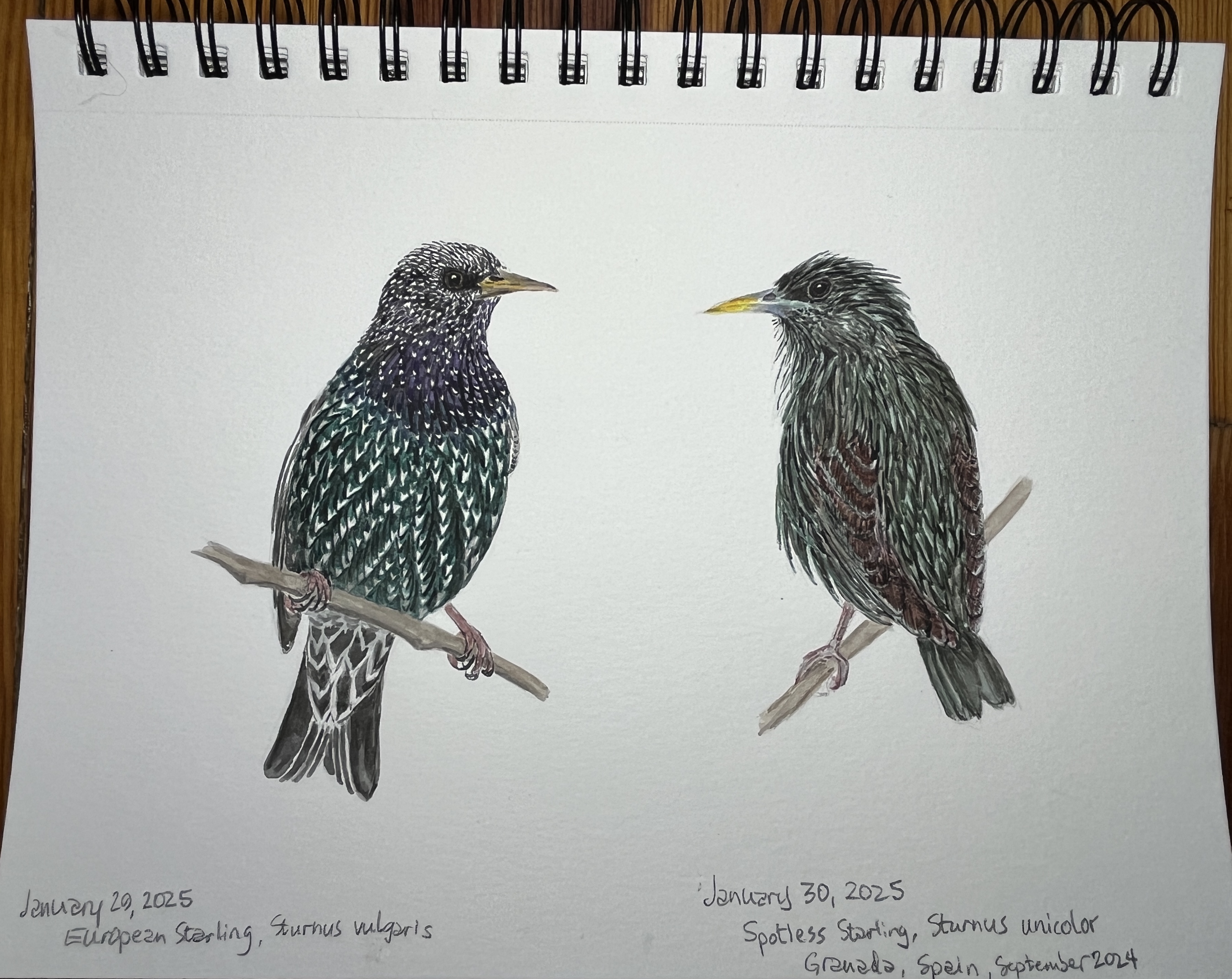
| Spotless Starling Sturnus unicolor Granada Spain, September 7, 2024 |
| Starlings, with and without spots European Starling and Spotless Starling |
![]() |
| Black-capped Chickadee, Poecile atricapillus on a branch of Staghorn Sumac, Rhus typhina |
| Spotless Starling Sturnus unicolor Granada Spain, September 7, 2024 |
| Starlings, with and without spots European Starling and Spotless Starling |
![]() |
| Black-capped Chickadee, Poecile atricapillus on a branch of Staghorn Sumac, Rhus typhina |
Today's painting was ambitious, and I finished only half of it. Tomorrow will be part two! Stay tuned... The familiar European Starling sports a really incredible coat in the non-breeding season - iridescent purple and green with little chevrons of white at the tip of each feather. When the breeding season rolls around, the feather tips have mostly worn away, leaving a uniform black-looking bird - this is called "wear molt" even though it's not technically a molt.
| European Starling, Sturnus vulgaris, in non-breeding plumage |
![]() |
| Eastern Bluebird, Sialia sialis, Windsor, Connecticut - male, perching on a poison ivy vine - |
Of Robins and Blackbirds... two hundred plus years ago, when the avifauna of this continent was being newly described to Western science, the describers were all European. They looked for similarities to what was familiar to them, and here's what we got... They had a robin so we got a robin (unrelated), they had a blackbird so we got a blackbird (unrelated). However OUR robin is related to THEIR blackbird. The family to which their robin belongs does not live in the Americas and the family to which our blackbird belongs lives ONLY in the Americas. Fun stuff. (Sizes are fairly accurate)
| UL: European Robin, Erithacus rubecula; UR: American Robin, Turdus migratorius LL: Red-winged Blackbird, Agelaius phoeniceus; LR: Eurasian Blackbird, Turdus merula |
Jorge has been having pretty good luck in his mini-quest to photograph all of the raptors of Horsebarn Hill. This one, however, was a big surprise. The Peregrine Falcon is not a regular visitor to the hill, though it is certainly found in many places in Connecticut. When it was up in this treetop, nothing else moved - even the starling flocks were quiet - the supreme aerial predator had arrived...
![]() |
| Peregrine Falcon, Falco peregrinus, Horsebarn Hill, Storrs Connecticut |
Five days left in our challenge... Today I thought it was time for a Junco-palooza. Our ubiquitous Dark-eyed Junco has many many subspecies, with subtly different plumages - decades ago we called our eastern form the Slate-colored Junco. During our April trip to Arizona we were excited to find another species, the Yellow-eyed Junco, up in the higher elevations of Mount Lemmon, near Tucson. Then in the low elevations of the Chiricahua Mountains, we saw the Gray-headed subspecies of the Dark-eyed Junco, and if we'd been paying closer attention, we might also have seen the Red-backed subspecies. And as a bonus, I've included the Volcano Junco from Costa Rica, which we saw in December 2023.
It's Saturday again, and we went out to one of my favorite nearby birding places, the Quinebaug Valley State Trout Hatchery. There's always something there - like Horsebarn Hill, there are local specialties, not necessarily unusual, but special anyway. You can always see a kingfisher, several species of ducks, a few different sparrows, and today we both had a "lifer"! But today's kingfisher reminded me that I missed one in my series of Coraciiformes a while back - so here today, is your Common Kingfisher, which I've placed beside the Arda River in Madzharovo, Bulgaria, where we saw it in September.
| Common Kingfisher, Alcedo atthis Arda River, Madzharovo Bulgaria, September 10, 2024 |
When we finish our January challenge a few days from now, I think I will share all of the photos Jorge took but didn't have space for here in our 31 days. Today was one of those days, so we chose the bird I mentioned above - a double-lifer! The Rusty Blackbird had been seen at the fish hatchery earlier this week and we hoped it would still be around today - our lucky day. This was a new species for both of us and we had great views!
![]() |
| Rusty Blackbird, Euphagus carolinus Quinebaug Valley State Trout Hatchery, Plainville Connecticut |
This morning was cold (10F) and bright, as it has been all week, and I spent some time with the Wilson's Snipe. This is the same individual Jorge photographed a few days ago, and it has continued feeding in one little stream of running water along the side of Horsebarn Hill. I didn't even open the car window, but used the binoculars to watch it probing the mud, snoozing, watching me, watching the harrier cruise overhead.
| field sketches of the snipe |
| Wilson's Snipe, Gallinago delicata Horsebarn Hill, Storrs Connecticut |
![]() |
| Blue Jay, Cyanocitta cristata Horsebarn Hill, Storrs, Connecticut |
I'm continuing with my dove studies, this time the subject is our local Mourning Dove. About a week ago Jorge took a fantastic photo of this species, which I used for the detailed pencil sketches - including the light blue orbital skin! I tried to keep the watercolor a little looser, using mostly a #12 Round, and painted the eye with a #0 Round.
| Mourning Dove, Zenaida macroura, pencil and watercolor |
![]() |
| Northern Mockingbird, Mimus polyglottos, Horsebarn Hill, Storrs Connecticut |
Overnight we had a few inches of fluffy snow, and the morning was quiet without wind, so the trees and bushes held delicate traceries of snow. My bird for today is a White-throated Sparrow, which, while it does breed in Connecticut, is seen in winter in larger numbers. I've shown it perched on a twig of yellow birch, with dormant leaf buds and catkins, and a puff of fluffy snow.
| White-throated Sparrow, Zonotrichia albicollis on Yellow Birch, Betula alleghaniensis |
![]() |
| Horned Lark, Eremophila alpestris, Horsebarn Hill, UConn campus |
![]() |
| Horned Lark, Eremophila alpestris, Horsebarn Hill, UConn campus |
On a roll with the browns and grays, and I wanted to go back to Arizona. What I chose was this pair of Gambel's Quails. Quails, like shorebirds, can have some complicated feather details, which I am not crazy about painting, but I stuck with it. They are gorgeous little birds, not sayin' they ain't, so fun to watch and not shy. We saw these at Cave Creek Ranch in Portal Arizona on April 5th, 2024.
![]() |
| Gambel's Quail, Calipepla gambelii Cave Creek Ranch, Portal Arizona |
![]() |
| Wilson's Snipe, Gallinago delicata Horsebarn Hill, UConn campus, Storrs Connecticut |
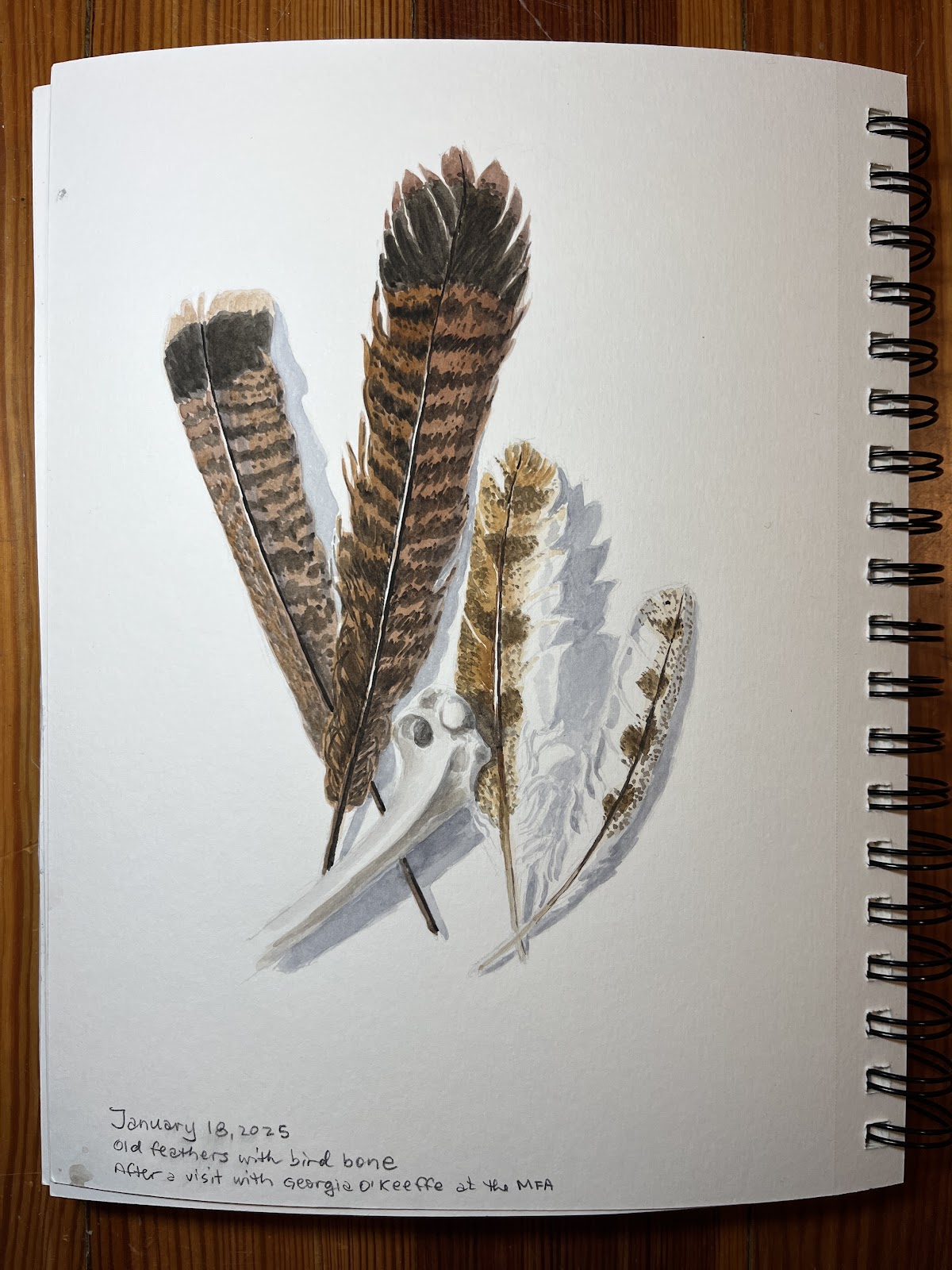
Today we took a field trip - to Cambridge to the birder-famous Mount Auburn Cemetery, and then across the river to Boston to the Museum of Fine Art. The special exhibition at the MFA was American painter Georgia O'Keeffe and English sculptor Henry Moore. They both had long and prolific careers spanning the middle decades of the 20th century, and both were inspired by nature and her varied forms. The only painting of Georgia's with bird related objects was a small still life that included a feather - a ruffed grouse I think. So I've used that as a jumping-off point for today's entry in our bird-a-day January challenge.
| Still life with old feathers and bird bone. Wild Turkey, Meleagris gallopavo, and Barn Owl, Tyto alba |
![]() |
| Pine Warbler, Setophaga pinus Mount Auburn Cemetery, Cambridge Massachusetts |
Another set of "seen from another angle" sketches. I'm liking this brown and gray palette - today worn by a female Northern Harrier. She is one of Jorge's favorite subjects on Horsebarn Hill, so I have a lot of reference photos. The head-on image is probably a juvenile - more buffy-colored.
| Northern Harrier, Circus hudsonius |
An owl is always an exciting find. This afternoon Jorge followed an ebird lead and got lucky. This Eastern Screech Owl has found a very roomy cavity in a large Sycamore tree for its daytime roost.
| Eastern Screech Owl, Megascops asio, Windsor Connecticut |
I had fun with the Carolina Wrens yesterday, so I did something similar with Great Blue Herons today - studies of different angles of the head. All done from photos of course, some of which were Jorge's. The one where it's looking straight-on is almost so strange I didn't include it, but there it is! Done with just a wash of black paint.
| Great Blue Heron, Ardea herodias |
![]() |
| Brown Creeper, Certhia americana Lyme, Connecticut |
The easiest way to portray a bird is in profile. Perhaps it's the best way to show the proportions - the length of the beak relative to the head, and so on. Today I'm trying to stretch my skills to show the bird in some different postures. This is one of our favorites, the Carolina Wren, whose cheerful song brings joy all spring and summer - really it does. And they stick around through the winter too, visiting our feeders and finding insects hidden in the woodpile.
| Carolina Wren, Thryothorus ludovicianus Storrs-Mansfield, Connecticut, year-round |
![]() |
| European Starling, Sturnus vulgaris UConn campus, Storrs, Connecticut |
As promised, here's the third in my Coraciiformes series. The European Bee-eater is one of 28 members of the genus Merops (the bee-eaters), and all are strikingly colorful birds. They're social, nesting in colonies of sand-bank burrows, and sometimes gather in large hunting and roosting flocks. The duo I've sketched is an immature in a crouched posture with an adult who's just caught a large wasp.
![]() |
| European Bee-eater, Merops apiaster Istanbul Turkiye, September 5, 2024 |
![]() |
| Bald Eagle, Haliaeetus leucocephalus Eagle Landing State Park, Haddam, Connecticut |
And quite possibly my favorite jay, the ubiquitous Blue Jay of Eastern North America. Cyanocitta cristata makes frequent forays farther west, especially in mountainous areas, which it shares with the equally stunning Steller's Jay, Cyanocitta stelleri - the only other member of the genus.
Every morning I take a handful of peanuts out to the feeding tray and sing out to "my jays" - Come for peanuts jay jay blue jay, come for peanuts! And by the time I'm back inside and the door has closed behind me they've arrived and are gobbling up the peanuts.
| Blue Jay, Cyanocitta cristata, Mansfield, Connecticut |
![]() |
| Ring-necked Duck, Aythya collaris, Mansfield, Connecticut |
It's another New Year's Day, but ten years have passed since I last posted on our AvesInArt blog. Do people still read blogs? I think birders do, I know I do anyway. Off we go then. Last week I randomly remembered that Jorge and I had done our January challenge ten years ago. January 1st thru 31st, 2015. Why not revive the blog by doing another January challenge?
Jorge's goal is to photograph a different species every day for thirty-one days. Sue's goal is to paint or sketch thirty-one birds seen in 2024. We had two fantastic trips last year - an April week in southeastern Arizona and two September weeks looping around Europe. It will be hard to choose my favorites.
![]() |
| Mexican Jay, Aphelocoma wollweberi, observed April 5th, 2024 Cave Creek Canyon, Chiricahua Mountains, Arizona |